
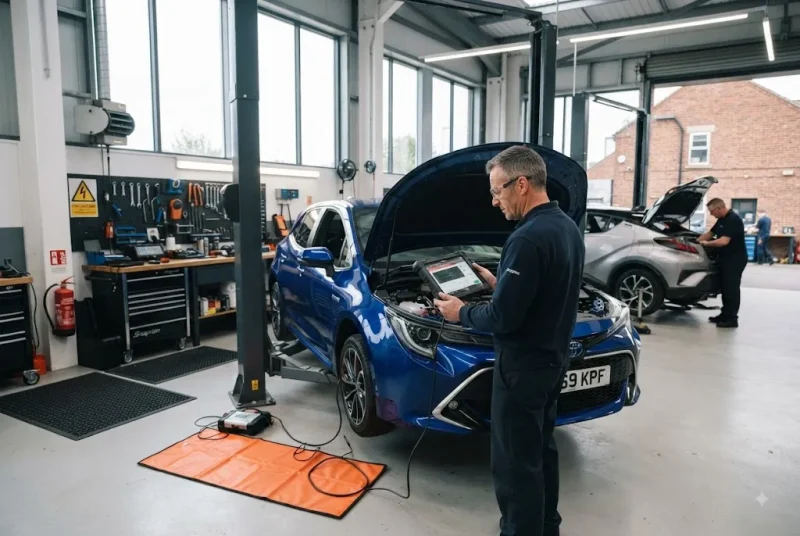

Hybrid servicing is becoming an increasingly important part of modern vehicle maintenance in the UK as more drivers choose cars that combine an internal combustion engine with electric-drive technology. Hybrid vehicles can deliver useful fuel-saving benefits in suitable driving conditions, but their maintenance requirements are not identical to those of conventional petrol or diesel cars.
A well-maintained hybrid can also support a longer vehicle life and more efficient operation. Regular inspections, correct servicing, battery-system checks and appropriate maintenance can help drivers get the most from the technology while reducing unnecessary component replacement. For workshops, this means combining traditional mechanical skills with knowledge of high-voltage electrical systems and hybrid-specific components.
This guide explains what hybrid servicing involves, why it matters, how Toyota hybrid service works, and how battery management and recycling fit into the wider sustainability picture.
Why Hybrid Servicing Is Different
Hybrid vehicles use more than one source of propulsion. Depending on the model, the vehicle may use a petrol engine alongside one or more electric motors and a high-voltage traction battery.
Some hybrid systems can recover energy during deceleration and braking, then use that stored energy to assist the vehicle later. This changes how certain components operate compared with a conventional vehicle.
At the same time, many ordinary maintenance requirements remain. Hybrid cars still have tyres, brakes, suspension, steering components, fluids, filters and other systems that need inspection or replacement according to the vehicle manufacturer’s requirements.
That combination means a hybrid workshop needs both conventional automotive knowledge and appropriate training for hybrid electrical systems.
What Does Hybrid Servicing Include?
The exact service schedule depends on the manufacturer, model, age and mileage of the vehicle. However, a professional hybrid service may involve several areas that go beyond a routine visual inspection.
Hybrid system diagnostics
Electronic diagnostics can help technicians identify faults within the hybrid control system, electric motor components and associated electronic systems. Accurate diagnostics are particularly important because a warning light may relate to an electrical, software or mechanical issue.
Using manufacturer-approved procedures and suitable diagnostic equipment can reduce the risk of replacing parts unnecessarily.
High-voltage system inspection
Hybrid vehicles contain high-voltage components that require appropriate safety procedures. Technicians working directly with these systems need suitable training, equipment and manufacturer-specific information.
Current Environment Agency guidance for permitted battery-treatment facilities states that activities involving high-voltage batteries, including testing, charging, discharging and dismantling EV or similar batteries, should be undertaken by appropriately trained and qualified technicians.
Although ordinary servicing does not necessarily involve dismantling a traction battery, the principle remains important: hybrid-specific work should be carried out by technicians with the appropriate competence.
Brake inspection
Regenerative braking can change the way a hybrid vehicle uses its conventional friction brakes. The electric motor can assist with deceleration and recover some energy, while conventional brakes remain available when additional stopping force is needed.
That does not mean the braking system can be ignored. Brake discs, pads, calipers and associated components still require inspection and maintenance according to the vehicle’s service requirements.
Tyres and wheel alignment
Tyres remain one of the most important contact points between a hybrid and the road. Incorrect pressure, uneven wear or poor alignment can affect handling, rolling resistance and efficiency.
Drivers who want to understand the connection between tyre condition, wear and vehicle efficiency can also read our guide to wheel alignment and tyre wear reduction.
Toyota Hybrid Service: What Owners Should Know
Toyota is one of the best-known manufacturers of hybrid vehicles in the UK, with a large range of self-charging hybrid models. Also Toyota UK states that its hybrid vehicles use an electric motor to help reduce fuel consumption and that its hybrid service includes checks of the hybrid system and hybrid battery.
Toyota UK currently states that its hybrid vehicles should generally be serviced every 12 months or 10,000 miles, whichever comes first, although owners should always follow the service requirements for their specific vehicle.
Toyota also describes a Hybrid Battery Extended Cover programme linked to qualifying servicing. According to the manufacturer’s current information, an annual Toyota Hybrid Service can make an eligible vehicle qualify for an additional year or 10,000 miles of hybrid battery cover, subject to the programme’s terms and limits.
This illustrates why manufacturer-specific servicing can be particularly relevant to hybrid owners. The best service schedule is not necessarily the same across every hybrid brand or model.
Hybrid Battery Maintenance and Health
The traction battery is one of the most important components in a hybrid vehicle. It stores electrical energy and works with the vehicle’s control systems and electric motor or motors.
Drivers sometimes assume that hybrid batteries require frequent replacement. In practice, battery life depends on factors such as vehicle design, operating conditions, age, usage and maintenance. A warning or performance issue should therefore be investigated rather than automatically treated as evidence that the entire battery needs replacing.
Professional diagnostics can help determine whether a problem relates to the battery itself, its cooling system, electrical connections, control electronics or another part of the hybrid system.
Battery cooling matters
Many hybrid vehicles use dedicated cooling systems to manage battery temperature. Keeping the relevant vents and components clean and unobstructed can therefore be important.
Owners should follow the manufacturer’s maintenance instructions rather than attempting to clean or modify high-voltage battery components themselves.
Battery faults should be diagnosed properly
A hybrid battery warning does not necessarily mean that the complete battery pack has reached the end of its useful life. A qualified technician can use appropriate diagnostic procedures to establish the cause.
This approach can reduce unnecessary component replacement and support the wider sustainability goal of keeping vehicles in service for longer.
Hybrid Services and Sustainable Mobility
Hybrid vehicles occupy an interesting position in the transition towards lower-emission transport. They retain an internal combustion engine while adding electric propulsion and energy recovery systems.
For some drivers, this can provide a practical step between conventional vehicles and fully electric cars. The environmental benefits of any individual vehicle depend on factors such as its model, driving conditions, fuel consumption, mileage and how it is used.
Servicing has a role in this picture because efficient vehicle operation depends on maintaining the systems that allow the car to perform as designed.
That means hybrid services are not only about repairing faults. They can also help maintain vehicle reliability, efficiency and useful operating life.
Battery Recycling: What Happens at the End of the Lifecycle?
Battery recycling is an important part of the sustainability discussion surrounding hybrid vehicles. Batteries contain valuable materials, but they also require specialist handling.
UK guidance distinguishes between different battery categories. Batteries used to propel electric and hybrid vehicles are classified as industrial batteries, while conventional starter batteries fall within the automotive battery category.
The Environment Agency states that waste industrial and automotive batteries must be handled through appropriate approved treatment or export arrangements and that vehicle and industrial batteries must not be sent to landfill or incineration.
This makes responsible battery management an important consideration for workshops dealing with end-of-life hybrid components.
Recovery of useful materials
Modern battery recycling processes can recover materials from spent batteries. Current Environment Agency guidance explains that battery treatment can separate materials such as metals, plastics and other fractions for further recovery. For lithium-ion batteries, processing can also produce a material commonly known as black mass, which can undergo further treatment to recover metals used in battery electrodes.
This is an important part of the circular economy because valuable materials can potentially return to industrial supply chains rather than being discarded.
Hybrid Maintenance Can Help Reduce Unnecessary Waste
One of the simplest ways servicing can support sustainability is by avoiding unnecessary parts replacement. Accurate diagnosis allows technicians to identify the actual cause of a fault rather than replacing multiple components on a trial-and-error basis.
Regular maintenance can also identify developing problems before they become larger failures. Maintaining tyres, brakes, cooling systems and other components can help prevent avoidable repairs and keep a vehicle operating for longer.
This fits into the wider environmental practices used by automotive service companies, where responsible operations include waste reduction, efficient resource use and appropriate management of replaced components.
How Hybrid Servicing Supports Vehicle Longevity
Vehicle longevity is an important but sometimes overlooked aspect of sustainable mobility. Manufacturing a replacement vehicle requires significant quantities of materials, energy and resources. Keeping a suitable existing vehicle in reliable service can therefore be relevant when considering its overall lifecycle.
Good servicing cannot eliminate every major repair, but it can help identify faults, maintain safety-critical systems and preserve vehicle performance.
For hybrid owners, this means following the manufacturer’s maintenance schedule, responding to warning lights promptly and using technicians with the appropriate hybrid training.
Can Independent Garages Service Hybrid Vehicles?
Yes, many independent garages can provide hybrid-related services, but customers should check that the workshop has the relevant equipment, training and experience for their particular vehicle.
Hybrid technology varies significantly between manufacturers. A technician who is experienced with one system may not automatically have the correct procedures or equipment for another.
Before booking, owners can ask whether the garage regularly works on their make and model, whether technicians have hybrid-specific qualifications and whether the workshop can perform the required diagnostic and safety procedures.
This is particularly important when the work involves high-voltage components rather than conventional maintenance.
What Hybrid Owners Should Check Between Services
Routine servicing is important, but drivers also have a role in maintaining their vehicles.
- Follow the manufacturer’s recommended service schedule.
- Pay attention to dashboard warning lights.
- Check tyre pressures regularly.
- Monitor unusual braking or driving behaviour.
- Keep battery cooling vents clear where the manufacturer permits owner cleaning.
- Report unusual battery, electrical or engine behaviour promptly.
- Use a suitably qualified technician for hybrid-specific repairs.
Drivers should never attempt to open or repair high-voltage battery systems without the appropriate training and equipment.
Hybrid Servicing and the Future of UK Automotive Workshops
The growth of hybrid vehicles is changing the skills required across the UK automotive aftermarket. Traditional mechanical knowledge remains essential, but workshops increasingly need technicians who understand electrical systems, electronic diagnostics, high-voltage safety and battery technologies.
This shift is also connected to the growth of fully electric vehicles. Many of the skills developed for hybrid servicing can provide a useful foundation for understanding the broader move towards electrified transport, although EVs have their own systems and servicing requirements.
As a result, workshops that invest in training, diagnostics and appropriate safety equipment will be better positioned to support drivers as the vehicle fleet evolves.
Choosing a Sustainable Hybrid Workshop
For drivers who want both reliable maintenance and responsible environmental practices, several questions can help when choosing a garage.
- Does the workshop have qualified hybrid technicians?
- Can it diagnose hybrid-specific faults?
- Does it follow manufacturer service requirements?
- How does it manage replaced batteries?
- How are other automotive waste streams handled?
- Does the business explain its environmental practices?
- Can it provide evidence of relevant hybrid training?
A workshop does not need to market itself as “green” to operate responsibly. Clear procedures, competent technicians and proper waste management are often more meaningful indicators.
Hybrid Servicing and the Wider Sustainable Automotive Cluster
Hybrid maintenance sits within a much broader movement towards sustainable automotive services. Garage chains are developing recycling and waste-management programmes, while independent workshops are adapting to new vehicle technologies and environmental expectations.
Tyre maintenance is another part of the picture because correct alignment and tyre condition can influence wear and vehicle efficiency. Likewise, the growth of electric vehicles is creating new requirements around battery servicing, high-voltage safety and charging-related systems.
Understanding these connections helps drivers see sustainability as more than simply choosing a particular type of vehicle. The workshop, maintenance schedule, replacement parts and end-of-life processes all contribute to the vehicle’s wider lifecycle.
Final Thoughts
Hybrid servicing combines conventional vehicle maintenance with specialist knowledge of electric motors, high-voltage systems, battery technology and electronic controls. For UK drivers, regular maintenance can help preserve reliability, safety and efficient operation while supporting a longer vehicle lifespan.
Toyota’s current UK service information demonstrates how manufacturer-specific hybrid checks can include inspection of the hybrid system and battery. Meanwhile, UK environmental guidance shows why responsible battery collection, treatment and recycling are essential when hybrid batteries eventually reach the end of their useful life.
As sustainable mobility develops, hybrid workshops will continue to play an important role between conventional automotive servicing and the increasingly electrified vehicle fleet. Choosing a properly equipped and appropriately trained workshop can help owners maintain their vehicles responsibly while making informed decisions about long-term maintenance.
