
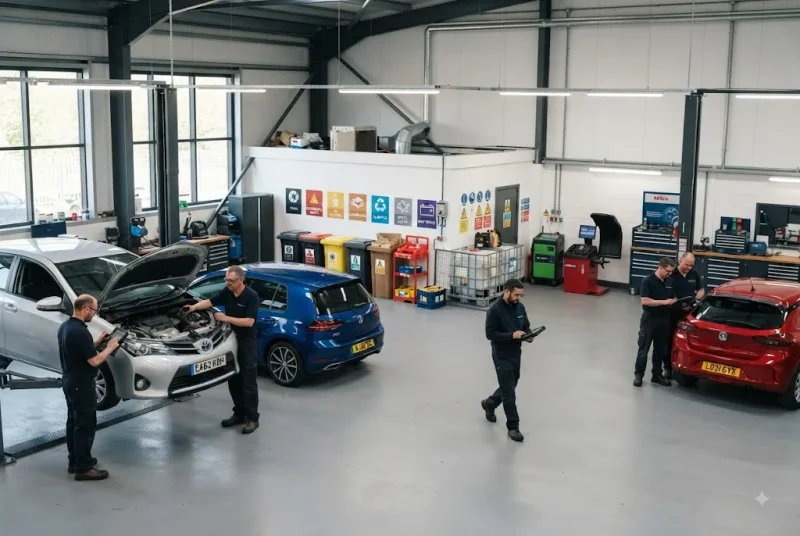

Automotive service companies play an important role in keeping vehicles safe, reliable and roadworthy, but their everyday operations can also create waste, consume energy and involve materials that require careful environmental management. From used engine oil and worn tyres to batteries, packaging, cleaning products and replacement parts, a modern workshop has many opportunities to improve how it manages resources.
For UK garages and repair businesses, environmental responsibility is increasingly about practical action rather than simply making sustainability claims. Waste reduction, energy efficiency, responsible storage, recycling and better purchasing decisions can all contribute to more responsible operations. At the same time, these measures can help workshops operate more efficiently and prepare for changes in the vehicle fleet.
This guide explains the key environmental best practices that automotive service companies can use across servicing, repairs, tyre work, diagnostics and general workshop operations.
Why Automotive Service Companies Need Environmental Best Practices
A vehicle workshop handles a wide range of materials every day. Some are relatively straightforward to recycle, while others require controlled storage, specialist collection or careful disposal.
Used oils, batteries, brake components, tyres, filters, coolants, solvents and contaminated materials can all create environmental risks if they are poorly managed. Even ordinary activities such as washing vehicles, cleaning floors or operating workshop equipment can affect water and energy consumption.
Environmental management therefore needs to be part of normal workshop operations. It should not be treated as a separate activity that only matters when a business is preparing an environmental statement or responding to regulation.
The Environment Agency’s current guidance for regulated waste facilities emphasises written management systems, staff competence, monitoring, maintenance, environmental objectives and continuous improvement. Although the exact requirements depend on the type of operation and permit involved, these principles provide a useful framework for understanding good environmental management. GOV.UK environmental management guidance provides further detail.
Automotive Service Companies and Waste Reduction
Waste reduction should begin before a material becomes waste. Workshops can often reduce unnecessary waste through better purchasing, accurate diagnosis, careful parts selection and improved inventory control.
Improve parts purchasing
Ordering the correct component the first time can reduce packaging, transport and the environmental impact associated with incorrect or unnecessary parts. Good stock control can also prevent products from becoming obsolete or damaged before they are used.
Where suitable, businesses can consider suppliers that use recyclable or reduced packaging. However, sustainability should never compromise the quality, compatibility or safety of a replacement component.
Repair where appropriate
Not every worn or damaged component needs to be replaced immediately. Where a safe and technically appropriate repair is possible, extending the useful life of a component can reduce material consumption.
The decision must always be based on manufacturer requirements, technical condition and road safety. Environmental considerations should support good engineering decisions rather than override them.
Separate waste streams
Effective waste segregation makes recovery and recycling easier. Instead of placing different materials into one general waste stream, workshops can create clearly identified areas for categories such as metals, tyres, batteries, cardboard, plastics and other relevant materials.
This approach also makes it easier for employees to understand what should happen to each type of waste.
Managing Used Oil and Workshop Fluids Responsibly
Used engine oil and other automotive fluids require particular care. Spills can contaminate floors, soil and drainage systems, while incorrect disposal can create environmental problems.
Workshops should use suitable containers, keep storage areas secure and inspect equipment regularly for leaks. Containers should be clearly labelled and appropriate for the materials being stored.
The Health and Safety Executive also provides specific guidance for motor vehicle repair activities involving lubricants, waste oil, fuels and other hazardous substances. Good environmental management and good workplace safety often overlap because preventing leaks and controlling exposure protects both people and the surrounding environment. HSE guidance for motor vehicle repair covers relevant control measures.
Workshops should also have a clear spill-response procedure. Staff need to know how to isolate a spill, use appropriate absorbent materials and prevent contaminated liquids from reaching surface-water drains.
Energy Efficiency in Automotive Workshops
Energy efficiency is another important part of responsible workshop operations. Automotive service businesses can use significant amounts of electricity and heating energy through lighting, vehicle lifts, compressors, diagnostic equipment, ventilation and other machinery.
The first step is understanding where energy is being consumed. Businesses can review utility bills, monitor major equipment and identify periods when systems are running unnecessarily.
Lighting and heating
Efficient lighting can reduce electricity use without reducing visibility in work areas. Heating systems should also be maintained correctly and controlled according to occupancy and working requirements.
Workshop doors are another consideration. Keeping large doors open unnecessarily during cold weather can increase heating demand. Simple operational procedures can therefore complement equipment upgrades.
Compressed air
Compressed-air systems are widely used in workshops, but leaks can waste energy. Regular inspections and prompt repairs can improve system efficiency while also supporting reliable workshop operations.
Equipment maintenance
Poorly maintained machinery may consume more energy and perform less efficiently. Scheduled maintenance can therefore contribute to both operational reliability and resource efficiency.
For businesses working with regulated waste streams, the Environment Agency specifically highlights monitoring and reviewing water, energy and raw-material use as part of process-efficiency practices.
Water Management and Pollution Prevention
Water use can easily be overlooked in an automotive workshop, particularly where vehicle cleaning, floor washing or equipment cleaning is part of the operation.
Businesses can reduce unnecessary consumption by using controlled cleaning systems, repairing leaks and avoiding excessive hose use. Where suitable, water may also be reused or recycled within systems designed for that purpose.
Pollution prevention is equally important. Cleaning liquids, oils and contaminated wash water should not be allowed to enter surface-water drainage systems. The Environment Agency’s current guidance recommends measures such as contained wash-water systems, suitable storage and pollution-prevention controls for relevant operations.
These practices are especially important for workshops operating near drains, waterways or environmentally sensitive areas.
Responsible Battery Management
Vehicle batteries deserve particular attention as the UK’s vehicle fleet becomes increasingly electrified. Traditional lead-acid batteries already require appropriate handling, while hybrid and electric vehicles introduce high-voltage battery systems with different technical and safety requirements.
Businesses should have clear procedures for storing, collecting and transferring waste batteries. Automotive batteries are subject to UK waste-management requirements, and the Environment Agency states that waste automotive and industrial batteries must be treated or recycled through appropriately approved arrangements.
For high-voltage systems, staff competence becomes even more important. The Environment Agency’s 2026 guidance notes that activities involving high-voltage batteries, including testing, charging, discharging and dismantling electric vehicle batteries, should be carried out by appropriately trained and qualified technicians.
This means environmental responsibility and technical capability increasingly need to develop together.
Tyre Waste and Resource Recovery
Tyres represent another significant material stream for automotive workshops. A busy garage can remove a substantial number of worn tyres over time, making responsible collection and recovery an important part of its environmental programme.
Workshops should use established waste-management arrangements and maintain records where appropriate. Good tyre management can also involve reducing premature tyre replacement through accurate inspection, correct inflation advice and suitable vehicle maintenance.
Tyre-related maintenance connects environmental responsibility with vehicle efficiency. For example, drivers looking to understand the relationship between alignment, tyre wear and efficiency can explore our guide to wheel alignment and tyre wear reduction.
The wider tyre-recycling sector is also developing new recovery methods. In 2026, the Environment Agency published a resource framework covering when tyre pyrolysis oil can meet end-of-waste criteria, illustrating the broader movement towards recovering value from end-of-life tyres.
Making Workshops More Eco-Friendly
Eco-friendly workshops do not need to transform their entire operation overnight. A practical environmental programme can begin with small changes and expand over time.
- Introduce clearly labelled waste-separation areas.
- Review how used oil and fluids are stored.
- Check workshops regularly for leaks and spills.
- Monitor electricity and water consumption.
- Replace inefficient lighting where appropriate.
- Maintain compressors, lifts and other equipment properly.
- Reduce unnecessary paper and printing.
- Choose suppliers with sensible packaging policies.
- Train employees on waste and pollution-prevention procedures.
- Keep records of environmental improvements.
The important factor is consistency. A workshop with a simple environmental system that employees actually follow can achieve more than a complex policy that exists only on paper.
Staff Training Is Central to Environmental Management
Even the best environmental policy can fail if employees do not know what to do. Workshop staff should understand how different waste streams are separated, how spills are managed, where fluids are stored and which procedures apply to batteries and other controlled materials.
Training should also be refreshed when equipment, processes or regulations change. New vehicle technologies make this particularly important because hybrid and electric vehicles introduce different servicing requirements.
HSE guidance for motor vehicle repair highlights the importance of controlling exposure to hazardous substances and provides task-specific information covering fuels, lubricants, waste oil, solvents, battery charging and vehicle exhaust fumes.
Measuring Environmental Performance
A workshop cannot easily improve what it never measures. Even a small independent garage can track a few practical indicators.
Useful measures might include monthly electricity consumption, water usage, quantities of tyres sent for recovery, waste-oil collections, general waste volumes and the amount of paper used. Larger automotive service companies can build more detailed environmental dashboards across multiple locations.
Regular measurement makes it easier to identify trends. If electricity consumption rises unexpectedly, for example, management can investigate whether equipment is being left running, whether heating controls have changed or whether maintenance is required.
Environmental performance should therefore be treated as an ongoing management process rather than a one-time project.
Independent Garages Versus Large Automotive Service Companies
Environmental responsibility is not exclusive to national networks. Independent garages can also implement strong environmental practices, sometimes with the advantage of being able to change procedures quickly.
Large automotive service companies, however, may have greater resources for formal environmental policies, staff training, supplier management, recycling contracts and energy-efficiency investments.
The most sustainable choice is therefore not automatically the largest company or the smallest garage. Drivers should look at the actual practices used by the workshop they plan to visit.
This also connects with the wider role of sustainable UK garage chains, where consistent environmental standards can potentially be applied across many service locations.
Preparing for Hybrid and Electric Vehicles
The UK’s transition towards electrified transport is changing what environmental responsibility means for automotive workshops. Traditional waste management remains important, but technicians also need the skills and equipment required to work safely on hybrid and electric vehicles.
Battery condition, high-voltage safety, electronic diagnostics and appropriate end-of-life processes are becoming increasingly relevant. Workshops that invest in training and suitable equipment can support longer vehicle lifecycles while reducing the need for premature replacement.
For motorists considering electrified vehicles, our forthcoming resources on hybrid servicing and sustainable EV maintenance provide further context on how workshops are adapting to these technologies.
How Customers Can Identify Responsible Workshops
Drivers do not need to become environmental specialists to assess a garage. A few simple questions can reveal how seriously a business approaches sustainability.
- How are old tyres handled after replacement?
- What happens to used batteries?
- How is waste oil collected?
- Does the workshop separate recyclable materials?
- How are spills and leaks prevented?
- Does the business provide hybrid or EV servicing?
- Does the workshop explain its environmental policies?
A transparent business should be able to explain its procedures clearly without relying solely on vague environmental language.
The Future of Responsible Automotive Service Operations
Environmental best practices are likely to become an increasingly important part of the UK’s automotive aftermarket. Vehicle technology is changing, customer expectations are evolving and businesses are facing greater pressure to use resources efficiently.
The most effective approach will combine environmental management with good technical work. A workshop that reduces waste but provides poor repairs is not sustainable in the wider sense. Likewise, a technically excellent business that repeatedly wastes materials or mishandles pollutants has room for improvement.
Responsible operations bring these priorities together. They help workshops protect the environment, manage resources, train their teams and maintain vehicles to a high standard.
Final Thoughts
Automotive service companies have many practical opportunities to improve their environmental performance. Waste reduction, responsible fluid management, tyre recovery, battery handling, energy efficiency, water conservation and staff training can all contribute to a more sustainable workshop.
The strongest environmental programmes are built into everyday processes rather than treated as a marketing exercise. By measuring resource use, improving waste practices and investing in staff capability, UK automotive businesses can become more efficient while supporting responsible vehicle ownership.
As hybrid and electric vehicles become increasingly important, these practices will become even more closely connected with the future of automotive servicing. Sustainability is therefore not simply an additional consideration for workshops; it is becoming part of how responsible automotive services operate.
