
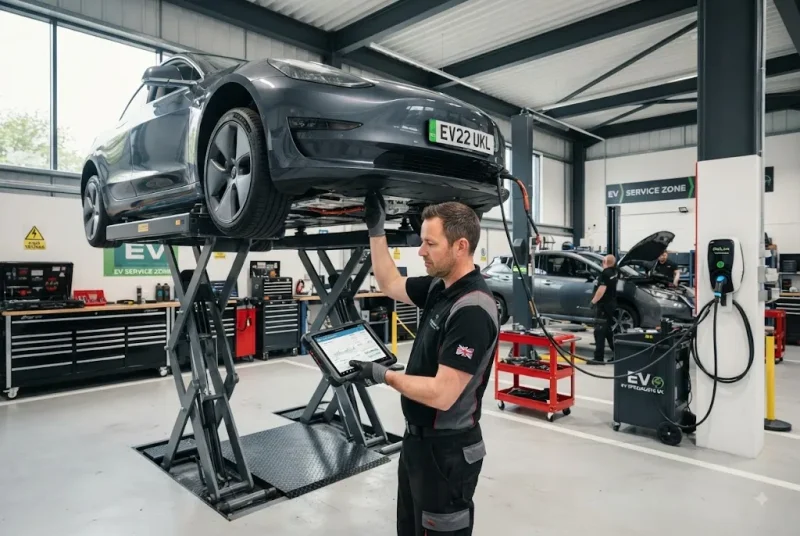

EV servicing is becoming an increasingly important part of the UK’s automotive sector as more drivers move from petrol and diesel vehicles to battery electric cars. Electric vehicles have fewer conventional mechanical components than combustion-engine vehicles, but that does not mean they require no maintenance. Batteries, brakes, tyres, suspension, steering, thermal-management systems, charging equipment and high-voltage electrical components all need appropriate attention.
For motorists, choosing the right workshop is particularly important because electric vehicles require specialist knowledge and safety procedures. A properly equipped garage can diagnose faults accurately, maintain important vehicle systems and manage battery-related work responsibly. At the same time, effective maintenance can support longer vehicle lifecycles and reduce unnecessary component replacement.
This guide explains what EV servicing involves, what EV mechanics need to know, how battery servicing fits into vehicle maintenance and why responsible battery management is an important part of sustainable electric transport.
Why EV Servicing Is Different From Conventional Car Maintenance
Battery electric vehicles do not use a conventional petrol or diesel engine, engine oil or many of the mechanical systems found in combustion-powered cars. However, they still contain sophisticated electrical, electronic and mechanical systems that require inspection and maintenance.
The most significant difference is the presence of a high-voltage traction battery and associated electrical components. These systems can operate at voltages far above the 12-volt electrical systems traditionally found in cars.
The Health and Safety Executive explains that electric and hybrid vehicles can contain direct-current voltages of up to 650 volts and that additional skills, training and specialist equipment may be necessary for people working on them. It also distinguishes between different levels of work, from general vehicle activities to maintenance and work directly on high-voltage electrical systems. HSE guidance on electric and hybrid vehicles provides detailed safety information.
This is why EV maintenance should be approached differently from routine servicing on a conventional vehicle.
What Does EV Servicing Include?
The exact requirements depend on the vehicle manufacturer, model, age, mileage and condition. A professional service can nevertheless cover several important areas.
Battery and electrical system checks
The traction battery is central to an electric vehicle’s operation. Technicians may use specialist diagnostic equipment to assess battery-related faults, warning messages and electrical-system performance.
A battery warning does not automatically mean that the entire battery pack needs replacement. Proper diagnosis can help establish whether the issue is related to the battery, thermal management, electrical connections, control electronics or another vehicle system.
Brakes and regenerative braking
Electric vehicles commonly use regenerative braking, which allows the vehicle’s electric motor to contribute to deceleration while recovering some energy. As a result, the conventional friction brakes may be used differently from those on a petrol or diesel vehicle.
However, brake pads, discs, calipers and other braking components still need appropriate inspection. Less frequent use of friction brakes does not mean that drivers can ignore them.
Tyres and suspension
Tyres remain critical on an EV because they influence grip, handling, road safety and energy consumption. Uneven wear can indicate alignment or suspension issues, while incorrect pressure can affect efficiency and tyre life.
Drivers interested in the relationship between tyre condition, alignment and vehicle efficiency can also explore our guide to wheel alignment and tyre wear reduction.
Cabin and thermal systems
Electric vehicles use different approaches to heating and cooling compared with conventional vehicles. Depending on the model, thermal management can involve the battery, electric motor, cabin and other electrical components.
Maintaining these systems correctly can help the vehicle operate within its intended temperature range and support efficient performance.
EV Mechanics Need Specialist Training
Not every garage is equipped to work on every electric vehicle. The level of competence required depends on the task being performed.
Routine maintenance that does not involve high-voltage components may require a different level of competence from work involving the traction battery or high-voltage electrical system. Workshops should therefore assess their technicians, tools, procedures and information before accepting specialist EV work.
HSE guidance states that people involved in electric and hybrid vehicle repair and maintenance are likely to need greater competence than those carrying out lower-risk activities. For work on high-voltage electrical systems, the guidance calls for suitable isolation procedures, testing and appropriate insulated tools and equipment.
For customers, this means it is sensible to ask a garage what EV training its technicians have and what types of electric vehicles it regularly services.
Electric Vehicle Maintenance Beyond the Battery
It is easy to assume that the battery is the only important component in an EV. In reality, electric vehicle maintenance covers many systems that are also found in other vehicles.
- Tyres and wheels
- Brake components
- Steering systems
- Suspension components
- Lights and electrical equipment
- Windscreen and washer systems
- Cabin filters and climate systems
- Charging equipment and connections
- Vehicle software and electronic systems
The UK’s MOT inspection manual specifically includes electric and hybrid vehicles within battery inspection requirements. It also warns that propulsion batteries carry high voltage and that damaged high-voltage components or cabling can present serious electrical hazards.
Owners should therefore continue to follow the manufacturer’s maintenance schedule even though an EV may require fewer conventional servicing tasks.
EV Battery Servicing and Battery Health
Battery health is one of the most important long-term considerations for electric vehicle owners. Modern EV battery systems are designed with sophisticated management systems that monitor factors such as temperature, charging and electrical performance.
Battery degradation happens over time, but the rate can vary according to the vehicle, battery technology, usage patterns, environmental conditions and charging behaviour.
Professional EV battery servicing is not necessarily about opening the battery pack. In many cases, diagnostics can help technicians identify abnormal behaviour or faults without dismantling the pack.
Why battery diagnostics matter
Accurate diagnostics can help distinguish between normal age-related degradation and a specific fault. This is important because replacing an entire battery pack can be a major intervention, while some problems may involve individual components or supporting systems.
For commercial electric vans and other vehicles, battery condition is also becoming an increasingly important consideration. The UK government’s 2026 guidance for zero-emission van and truck grants specifically addresses how manufacturers can provide evidence concerning battery degradation, highlighting the growing importance of battery performance over a vehicle’s useful life.
EV Battery Servicing Requires Careful Safety Procedures
High-voltage battery work should not be treated as an ordinary DIY repair. A traction battery can retain significant electrical energy even when a vehicle appears to be switched off.
HSE guidance recommends isolating high-voltage systems and proving them dead before relevant work begins. It also states that suitable tools and test equipment should be used and that manufacturer information should be consulted for vehicle-specific procedures.
This makes technician competence particularly important when a repair involves damaged cables, battery packs, electrical components or collision-related damage.
Owners should never attempt to open, dismantle or repair a high-voltage battery without the appropriate training, equipment and procedures.
Charging Infrastructure and EV Maintenance
Charging infrastructure is another important part of electric vehicle ownership. The vehicle’s charging system, cable and connection points all need to function correctly for reliable charging.
For home or workplace chargepoint installations, customers should use appropriately authorised installers and ensure the installation meets the relevant requirements. Current UK government guidance for authorised chargepoint installers states that installers must use eligible chargepoint models, test installations for safety and provide the required documentation. GOV.UK chargepoint installation guidance provides current information for installers and customers.
Garage technicians do not necessarily install every type of charging infrastructure, but understanding charging systems can help them diagnose vehicle-side charging problems and advise customers when a fault may be related to the vehicle or the charging equipment.
Vehicle-side charging problems
If an EV refuses to charge, the cause may not always be the battery. Potential issues can involve the charging cable, vehicle connector, onboard charger, software, electrical supply or charging station.
Proper diagnostics can help identify the source rather than replacing expensive components unnecessarily.
Battery Lifecycle and Sustainable EV Servicing
Sustainability in EV servicing extends beyond keeping a vehicle running. Eventually, batteries and other components reach the end of their useful lives, creating a need for responsible reuse, treatment and recycling.
The Environment Agency’s current 2026 guidance for permitted battery-treatment facilities sets out measures for handling waste batteries, including sorting, testing, charging, discharging and dismantling. It states that activities involving high-voltage EV batteries should be carried out by appropriately trained and qualified technicians.
The same guidance requires appropriate procedures and dedicated areas for relevant battery activities. It also highlights controls for risks such as short circuits, fire, leakage and thermal runaway.
This demonstrates why battery lifecycle management needs specialist infrastructure rather than ordinary waste disposal.
From Battery Reuse to Recycling
When an EV battery is no longer suitable for its original application, its next step does not necessarily have to be immediate recycling. Depending on its condition and technical suitability, some batteries or components may have opportunities for reuse or further processing.
Where recycling is appropriate, treatment can recover useful materials. The Environment Agency’s battery guidance describes processes that can separate battery materials and, for lithium-ion batteries, produce intermediate materials such as black mass for further recovery.
This supports the concept of a battery lifecycle in which valuable resources remain within productive use for as long as possible.
How EV Servicing Supports Clean Transport
Electric vehicles are generally associated with the wider transition towards cleaner road transport, but the sustainability story does not end when a vehicle leaves the dealership.
Keeping an EV in good working condition can help maintain its usefulness over a longer period. Accurate diagnostics, appropriate repairs and responsible component management can reduce unnecessary replacements and support vehicle longevity.
This is particularly relevant because manufacturing vehicles and their batteries requires significant materials and energy. Extending the useful life of an existing vehicle can therefore be an important part of considering its overall lifecycle.
The same principle applies to workshop operations. Sustainable automotive service companies and eco-friendly workshops can reduce waste, improve energy efficiency and manage replaced components responsibly.
Can Independent Garages Provide EV Servicing?
Yes, independent garages can service electric vehicles, but capability varies significantly from one business to another.
Before booking an EV with an independent workshop, owners should check whether the garage has the necessary equipment, technician training and manufacturer information for the specific vehicle.
Useful questions include:
- Does the garage regularly service electric vehicles?
- Are technicians trained to work safely around high-voltage systems?
- Can the workshop perform EV-specific diagnostics?
- Can it inspect charging-related faults?
- How does it handle damaged or replaced batteries?
- Does it follow manufacturer-specific procedures?
A garage does not need to be a large national chain to provide quality EV maintenance. What matters is whether it has the competence, equipment and procedures required for the work.
How EV Owners Can Maintain Their Vehicles
Owners can support the long-term condition of an electric vehicle through simple maintenance habits. The manufacturer’s handbook should always take priority because charging recommendations and maintenance schedules vary between models.
- Follow the manufacturer’s servicing schedule.
- Check tyre pressures regularly.
- Pay attention to unusual warning messages.
- Have braking components inspected as recommended.
- Keep charging connectors clean and undamaged.
- Use compatible charging equipment.
- Report unusual battery or charging behaviour promptly.
- Use qualified technicians for high-voltage work.
Drivers should also remember that an EV still needs to remain roadworthy. GOV.UK states that drivers are responsible for ensuring their vehicles are safe to drive and highlights routine checks covering brakes, lights, tyres and other vehicle systems.
EV Servicing and Workshop Sustainability
There is a strong connection between EV maintenance and wider environmental best practices in the automotive industry. An electric vehicle may eliminate tailpipe emissions during operation, but workshops still need to manage their own environmental impact.
Responsible workshops can reduce waste through accurate diagnosis, careful parts selection, appropriate battery management and recycling arrangements. Energy-efficient equipment, responsible fluid handling and good waste segregation can also contribute to greener operations.
This is particularly relevant as more garage chains and independent businesses invest in EV capability. The environmental benefits of cleaner transport are supported by the wider network of businesses that maintain, repair and eventually process the vehicles and their components.
Choosing an EV Workshop in the UK
When comparing EV mechanics, price should not be the only consideration. Technical competence is particularly important for work involving high-voltage systems.
A suitable workshop should be able to explain what service is required, what checks will be carried out and whether any work involves high-voltage components. Transparency about technician training and diagnostic capability can help customers make an informed decision.
It is also worth asking how replaced batteries and other EV components are managed. A workshop that has clear arrangements for responsible waste handling is better positioned to support the wider sustainability objectives of electric transport.
The Future of EV Servicing in the UK
The UK’s automotive aftermarket is adapting as the electric vehicle fleet grows. Future workshops will need to combine traditional skills such as brakes, tyres and suspension maintenance with increasingly advanced electrical and software-based diagnostics.
Battery technology will also remain an important area. Technicians and waste-treatment specialists will need appropriate training as batteries become more widespread and more vehicles eventually reach the later stages of their lifecycle.
Charging infrastructure is another area of development. As home, workplace and public charging expands, technicians may increasingly encounter vehicle-side charging faults and customers seeking advice about charging-related problems.
The result is a broader definition of automotive servicing. Instead of focusing only on mechanical repairs, modern workshops increasingly need to understand electrical systems, battery technology, software, charging and sustainable resource management.
Final Thoughts
EV servicing is an essential part of maintaining electric vehicles safely, efficiently and responsibly. Although EVs generally have fewer traditional mechanical components than combustion-engine cars, their high-voltage systems and battery technology require specialist knowledge and appropriate safety procedures.
Professional maintenance can cover battery diagnostics, braking systems, tyres, suspension, charging-related equipment, thermal systems and electronic controls. At the same time, responsible battery management is becoming an important part of the vehicle’s wider lifecycle.
For UK drivers, the best approach is to choose an EV workshop with suitable training, diagnostic equipment and clear procedures for high-voltage work. As electric vehicles become a larger part of the country’s transport system, capable EV mechanics and responsible servicing businesses will play an increasingly important role in supporting clean transport and longer vehicle lifecycles.
