
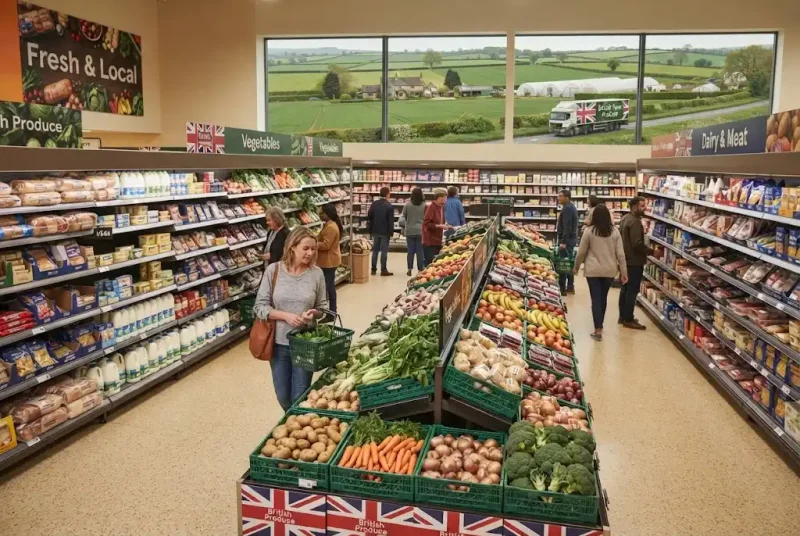

Food Security UK is about more than whether enough food exists on supermarket shelves. It also concerns whether people can afford and access an adequate diet, whether food supplies can withstand disruption, and whether the UK’s farming, manufacturing, distribution and retail systems remain resilient. Recent evidence shows that food insecurity continues to affect households across the country, while government strategies are addressing affordability, sustainability, resilience and the wider food system.
For consumers, businesses and policymakers, understanding food security in the UK requires looking at several connected issues. Domestic production, imports, food prices, household incomes, climate pressures, supply-chain disruption and access to healthy food all influence how secure the food system is.
What Does Food Security UK Mean?
Food security generally refers to reliable access to sufficient, safe and nutritious food. In the UK context, this involves both the resilience of the national food system and people’s ability to obtain food.
These are related but different questions. The country can have food available through domestic production and international trade while some households still struggle to afford a healthy diet. Conversely, temporary disruption to farming, transport, energy or international trade can create wider risks even when supermarkets remain well supplied.
The government’s food strategy describes a secure food supply as one that can operate in an unpredictable world while supporting an affordable and sustainable food system.
Food Security in the UK: The Current Picture
The latest available Food Foundation data shows that food insecurity remains a significant issue. In July 2026, its survey found that 12.2% of UK households were experiencing food insecurity, equivalent to approximately 6.5 million adults and 2.2 million children living in food-insecure households. The organisation also reported that 16.7% of households with children were affected.
These figures describe household access to food rather than the UK’s ability to produce or import food. That distinction is important because national food-system resilience and household food affordability are separate dimensions of food security.
The Food Foundation also reported that almost one in ten households had accessed food support during the previous six months in its July 2026 survey.
Food Poverty and Household Affordability
Food poverty is closely connected with food insecurity because household finances affect the ability to purchase sufficient nutritious food. When budgets become stretched, families may change what they buy, reduce portions, skip meals or choose cheaper foods.
The Food Foundation reported in 2026 that 39% of surveyed households said food was more difficult to afford than a year earlier, while 41% were concerned about being able to afford food during the following month. Among food-insecure households, the organisation found that many had reduced purchases of fruit and vegetables.
This affordability issue is important when considering healthy eating. The Food Foundation’s Broken Plate 2025 report found that healthier foods were more than twice as expensive per calorie as less healthy foods, based on its analysis.
That means food security cannot be considered only in terms of calories or the physical availability of food. The quality, affordability and accessibility of food also matter.
Why Food Security UK Depends on Domestic Production
British agriculture provides an important foundation for national food resilience. The government’s 2022 food strategy reported that the UK produced around 60% by value of all the food it consumed, increasing to 74% of food that could be grown or reared domestically.
However, domestic self-sufficiency is not identical to food security. The same government strategy emphasised that international trade gives the UK access to a wider range of products and supply sources. Imports therefore form an important part of the overall food system.
This balance means that a resilient UK food system needs both productive domestic agriculture and dependable international trading relationships.
Climate Change and UK Food Supply
Climate conditions can affect food production directly through drought, flooding, heat, changing growing seasons and pressure on crops and livestock. They can also affect food prices and international supply chains when production problems occur in other countries.
Government food policy therefore increasingly connects food security with environmental sustainability. The 2025 UK government food strategy for England identifies a healthier, more affordable, sustainable and resilient food system as its overall direction, while considering the wider UK food system.
For consumers, this can influence the availability and cost of particular foods. For farmers and food businesses, it can mean adapting production methods, improving resource efficiency and preparing for greater environmental uncertainty.
The National Food Strategy and UK Food Strategy
The phrase National Food Strategy is commonly associated with the independent review led by Henry Dimbleby. The government subsequently published its own UK Food Strategy in 2022, explaining measures intended to support a prosperous agri-food sector, healthier diets, sustainability and a secure food supply.
Food policy has continued to develop. In July 2025, the government published A UK government food strategy for England, considering the wider UK food system. It sets out a vision for a healthier, more affordable, sustainable and resilient food system and identifies priority outcomes intended to support that vision.
Because many aspects of food policy are devolved, approaches can differ between England, Scotland, Wales and Northern Ireland. Readers should therefore distinguish between UK-wide food-system issues and policies applying specifically to England.
How Government Policy Can Affect Food Security
Food security policy covers much more than farming. Several areas can influence the resilience and affordability of the food system.
- Agriculture: Supporting productive and sustainable domestic farming.
- Trade: Maintaining access to diverse international sources of food.
- Food safety: Protecting consumers and maintaining confidence in the food supply.
- Household support: Helping people access adequate food when household finances are under pressure.
- School food: Providing children with access to nutritious meals.
- Environmental policy: Supporting a food system capable of adapting to environmental pressures.
- Supply-chain resilience: Preparing for disruption involving transport, energy, labour or international markets.
The Food Standards Agency also has an important role in food safety and consumer interests across England, Wales and Northern Ireland, while Food Standards Scotland operates independently in Scotland.
Food Security and School Meals
Children’s access to nutritious food is an important part of the wider food-security discussion. School meal programmes can provide a dependable source of food during the school day, particularly for families experiencing financial pressure.
The Food Foundation’s 2025 evidence pack on free school meals highlighted the continued presence of food insecurity among households with children and examined evidence around the health, educational and economic effects of school meals.
Free school meals are therefore often discussed alongside broader measures addressing child poverty, household income and access to healthy food. They are one part of a wider set of interventions rather than a complete solution to household food insecurity.
The Role of Food Charities
Food charities and community organisations can provide immediate assistance to people experiencing food insecurity. Food banks, community food projects, school initiatives and local support organisations can help households access food when their normal resources are insufficient.
However, charitable food support and long-term food security are not the same thing. Charities can help meet immediate needs, while longer-term solutions involve the underlying affordability, income, housing, employment, food pricing and policy conditions that influence whether households can consistently afford an adequate diet.
People interested in the sector may encounter searches for food for life charity or food charity jobs. When researching any organisation or employment opportunity, it is sensible to check the organisation’s current official information, role descriptions and charitable status rather than relying on third-party summaries.
Food Businesses and Supply-Chain Resilience
Food manufacturers, wholesalers, retailers, restaurants and hospitality businesses all form part of the UK’s food system. Their ability to manage stock, suppliers, energy costs, transport and workforce requirements can affect how efficiently food moves from producers to consumers.
This makes resilience an important consideration beyond government policy. Businesses can reduce vulnerabilities by reviewing supplier dependencies, maintaining appropriate contingency plans, monitoring market conditions and improving operational efficiency.
Food manufacturers also have a role in developing products that are affordable, safe, nutritious and appropriate for changing consumer needs. Readers interested in this part of the sector can explore OceanFeed UK’s coverage of Food Manufacturers UK and food and beverage manufacturing.
Reducing Food Waste as a Food Security Measure
Food waste represents another part of the wider food-system challenge. Food that is produced, transported and purchased but never eaten represents wasted resources, including land, water, energy, labour and transport capacity.
Reducing avoidable waste can therefore improve efficiency throughout the food system. At household level, practical steps include planning meals, checking existing ingredients before shopping, storing food appropriately and understanding date labels.
For food businesses, better stock management, accurate forecasting and appropriate redistribution can help reduce unnecessary waste while improving operational efficiency.
What Could Improve Food Security UK?
There is no single solution to food insecurity or food-system vulnerability. Future progress is likely to involve several areas working together.
Improve Access to Affordable Healthy Food
Food needs to be financially accessible as well as physically available. Policies and commercial practices that improve access to affordable nutritious foods can help address the household dimension of food security.
Strengthen Domestic Food Production
Maintaining productive British agriculture can provide an important layer of resilience. This includes supporting farmers while considering soil health, water availability, biodiversity, productivity and climate adaptation.
Maintain Diverse Supply Sources
International trade provides access to foods that cannot be produced efficiently or reliably in the UK. A diverse range of supply sources can help reduce dependence on a single origin or route.
Support Children and Vulnerable Households
Evidence consistently shows that some groups experience higher levels of food insecurity. The Food Foundation’s 2026 data identified particularly high levels among single-parent households, households receiving Universal Credit and households including someone affected by disability.
Build Climate-Resilient Food Systems
Farmers, manufacturers, retailers and policymakers all need to consider how changing environmental conditions could affect food production and distribution. Greater resilience can reduce the impact of future disruptions.
How Consumers Can Support a More Resilient Food System
Individuals cannot solve national food-security challenges alone, but everyday choices can still contribute to a more resilient food system. Buying seasonal foods, reducing avoidable food waste, supporting local producers where practical and learning how to store food correctly can all reduce unnecessary pressure on resources.
Consumers can also become more informed about ingredients, nutrition and dietary choices. OceanFeed UK’s guides to Food Facts and Nutrition, Explore Food and Food Selection Factors provide useful related reading.
Food Security UK: Looking Ahead
The future of Food Security UK will depend on how effectively the country balances affordability, domestic production, international trade, sustainability and resilience. Current government strategies recognise that these areas are interconnected, while recent evidence demonstrates that household food insecurity remains a significant challenge.
Future solutions are therefore likely to involve a combination of agricultural policy, food-system investment, supply-chain planning, environmental adaptation and measures that help households afford nutritious food.
For readers exploring the wider food landscape, OceanFeed UK’s British delicacies guide provides a different perspective on the country’s food culture, while party platters and sharing boards looks at how food is prepared and enjoyed in group settings.
Final Thoughts
Food Security UK encompasses the resilience of the national food supply and the ability of households to access adequate, affordable and nutritious food. Domestic farming, international trade, food safety, environmental resilience and household affordability all play distinct roles.
Recent evidence shows that food insecurity remains a substantial issue, while government food strategies continue to focus on creating a healthier, more affordable, sustainable and resilient food system.
Understanding these different dimensions makes the subject easier to navigate. Rather than viewing food security simply as a question of whether food is available, it is more useful to consider the complete journey from farm and manufacturer to shop, household and plate.
