
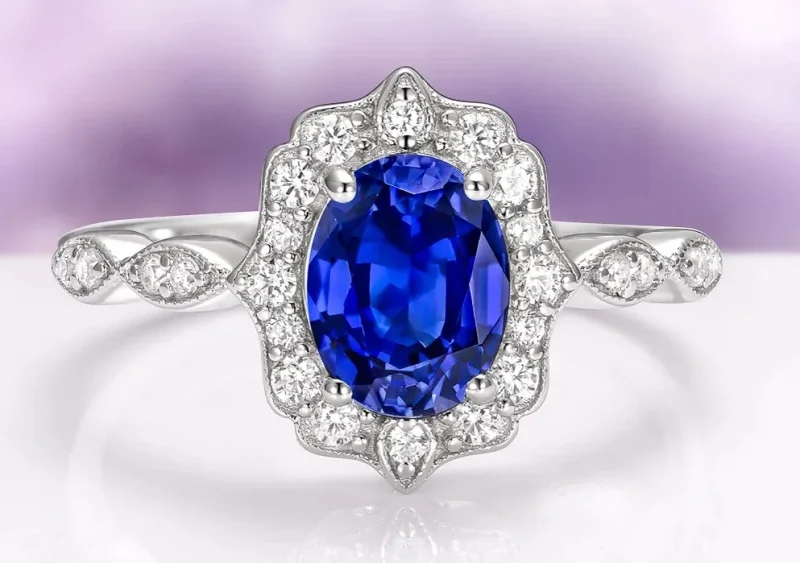

Some rings shout. A well-made vintage-style sapphire engagement ring does the opposite. It draws you in slowly, rewarding the second and third look with detail you missed the first time. That restraint is exactly why designs borrowed from the early twentieth century keep coming back into favor. They were built for close looking, not for a single glance across a room, and a deep blue sapphire suits that patient kind of beauty better than almost any other stone.
How Art Deco geometry flatters a sapphire
Art Deco design leans on symmetry, clean lines, and calm repetition. Think stepped shoulders, framed halos, and the kind of squared-off outlines that feel architectural rather than fussy. A sapphire, with its steady saturated color, sits inside that structure beautifully. The straight lines of a Deco setting give the eye a border, and the stone becomes the still center of a very deliberate composition. Because sapphire holds its tone across many lighting conditions, it anchors geometric framing in a way a paler stone can struggle to do. If you have ever wondered why colored stones feel so at home in older designs, it helps to remember the long history behind engagement gemstones and how sapphire in particular has signaled constancy for centuries. The geometry is modern in feel, but the instinct behind it is old.
The quiet craft of milgrain and filigree
Milgrain is the row of tiny beaded dots that runs along an edge, and filigree is the fine openwork that fills the spaces a plainer ring would leave blank. Neither shouts for attention, which is the point. Up close they read as care, as time spent, as a maker who refused to leave a surface flat. On a sapphire ring these details do real work. The soft texture of milgrain catches light differently than the smooth face of the stone, so the setting and the sapphire play off each other instead of competing. Filigree, meanwhile, keeps a ring from feeling heavy even when the design is elaborate. It lets light travel through the piece. The result is a ring that looks intricate but wears light, which is a large part of what people mean when they call a design timeless.
Old-cut character versus modern-cut precision
Older stones were cut by hand and by eye, before the era of laser measurement, so they carry small irregularities that modern cutting removes. Those irregularities are not flaws so much as fingerprints. An old-style cut tends to return light in broad, soft flashes rather than the sharp uniform sparkle of a contemporary cut. For a sapphire, that softer return can feel warmer and more romantic, a glow rather than a glitter. A modern cut, by contrast, maximizes brightness and consistency. Neither is better in the abstract. The choice is really about the mood you want. If you love the sense that a ring has a history, an old-cut character suits you. If you want crisp, even brilliance, a modern cut delivers it. Many vintage-style rings today blend the two, pairing an antique-inspired outline with a cleanly finished center.
 A vintage-leaning sapphire ring where the detailing does real work.
Why a sapphire reads as an heirloom
There is something about a blue sapphire that makes a ring feel as though it already has a past. Part of it is color memory. Sapphire has been associated with faithfulness and steadiness for a very long time, and that association clings to the stone even in a brand-new design. Part of it is simple visual weight. A saturated blue stone looks considered rather than trendy, the sort of choice a family might have made a generation ago and passed down. When you set that stone in a vintage-inspired mount, the two signals reinforce each other. The ring stops looking like something bought last season and starts looking like something inherited. That heirloom quality is emotional as much as visual, and it is very hard to fake with a stone that reads as fashionable rather than enduring.
Blending a vintage look with everyday durability
A common worry about vintage-style design is that all that fine detail might feel too delicate for daily life. In practice, good modern making answers that worry. Contemporary setting techniques let a jeweler recreate milgrain, filigree, and Deco framing while seating the stone securely and finishing the metal cleanly. Sapphire itself helps here, because it is one of the harder gemstones and stands up well to ordinary wear. So you can carry the look of a hundred-year-old ring without carrying its fragility. When people browse a vintage sapphire engagement ring today, they are usually looking at exactly this combination: an antique sensibility executed with current craftsmanship. The style is a nod to the past, but the construction is built for a life lived now, from commutes to keyboards to washing up.
Telling genuine vintage-inspired design from costume pastiche
Not every ring that calls itself vintage earns the label. There is a real difference between a design that understands why old rings looked the way they did and one that simply glues on a few decorative cues. A few things separate the genuine from the costume version:
- Detail that is consistent. Real milgrain runs evenly and intentionally, not just where it is easy to add.
- Proportion that feels balanced. Deco design is about symmetry, so a top-heavy or lopsided outline is a tell.
- Openwork that actually opens. Filigree should let light through, not sit as a solid stamped panel pretending to be openwork.
- A stone that suits the setting. A sapphire chosen for steady color reads as heirloom; a flashy mismatched center breaks the spell.
You do not need to be an expert to spot these. Slow down, look closely, and ask whether every detail has a reason to be there. Genuine vintage-inspired design will hold up to that scrutiny. Pastiche falls apart under it.
What to take away
The appeal of a vintage-style sapphire engagement ring is not nostalgia for its own sake. It is a preference for design that respects the person wearing it enough to reward attention. Deco geometry gives the ring a calm structure, milgrain and filigree give it warmth, an antique-inspired cut gives it character, and the sapphire ties it all to a long tradition of meaning. Choose a piece where every element earns its place, and you end up with something quiet, considered, and made to be looked at for years. That is the whole point of the style, and it is why it never really goes out of fashion.
