
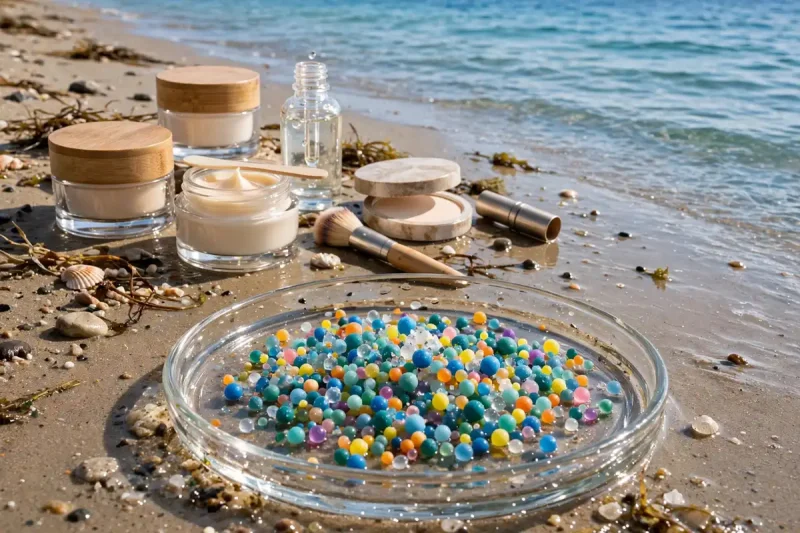

Microplastics in cosmetics are tiny plastic ingredients hidden in everyday skincare, makeup and personal care products. Brands may add them to exfoliate, thicken, smooth, add shimmer or help a formula spread evenly and feel silky. If you want to know where they are most likely to hide, this guide answers that question directly. It also explains how they can reach rivers and the sea, and how to spot them on a label. It explains microplastics in cosmetics in plain terms and shows how to choose plastic-free alternatives with confidence.
Unlike a plastic bottle or jar, which you can see, refuse or recycle, these ingredients are invisible in use. That is why label reading matters. Once you know the names to look for, spotting cosmetic microplastics becomes much easier. Your bathroom shelf then becomes a practical place to cut plastic pollution.
What Are Microplastics in Cosmetics?
Microplastics are very small pieces of plastic. In cosmetics, the term usually covers plastic ingredients that brands make and add on purpose. It does not cover fragments that have broken down from larger items in the environment. Some are solid particles, such as tiny beads, powders or glitter. Others are synthetic ingredients that form a light film on the skin or hair. They can control shine, improve texture or keep a product feeling smooth instead of sticky or heavy.
Because they do a useful job in a formula, cosmetic microplastics can turn up in places you might not expect. A scrub may feel effective. A foundation may glide on more easily. A powder may look soft and even, partly because of what these ingredients do. That usefulness is also why they are easy to overlook. The product works and the packaging looks ordinary. Nothing on the front of the pack announces that plastic is inside the formula itself.
It helps to separate ingredients from packaging. A cream in a glass jar can still contain plastic ingredients. A product in a plastic tube may contain none. Both issues matter, but they are not the same problem. This article focuses mainly on what is inside microplastics beauty products. It also remembers that bottles, pumps and tubes add to the wider footprint of a routine.
Where Microplastics in Cosmetics Are Most Likely to Hide
There is no single place to look, because different products use plastic ingredients for different reasons. The sections below cover the categories where shoppers most often ask questions, from daily skincare to the makeup bag.
Microplastics Skincare: Scrubs, Cleansers and Creams
Questions about microplastics skincare products often start with exfoliators. Facial scrubs, body scrubs and polishing cleansers are the most obvious place to check. Brands traditionally created that gritty or smooth, bead-like texture with plastic particles. Cleansers and face masks are also worth checking, especially products that promise a polishing, smoothing or blurring effect.
Leave-on products deserve attention too. Moisturisers, primers and serums may use plastic-based ingredients to improve glide, reduce tackiness or leave a soft-focus finish. You cannot tell simply by looking at the texture, and a higher price is no guarantee either way. The ingredient list, not the branding, is the reliable place to check.
Microplastics Makeup: Shine, Glide and Glitter
With microplastics, makeup raises its own set of questions. Foundations, primers and powders may use plastic ingredients to help pigment spread evenly. They can also control shine or create a matte, blurred look. Lip products, eye products and highlighters can also rely on them for glide and wear. Glitter products are a category to examine closely, because conventional glitter is itself a plastic material.
This does not mean every item in your makeup bag contains them. Formulas vary widely between brands and even between shades and finishes. That is why checking the products you use most often is a sensible place to begin. Start with the ones you rinse or remove every day.
Microbeads in Cosmetics and the UK Ban
The microbeads cosmetics brands once added to rinse-off scrubs and cleansers are the best-known example of cosmetic microplastics. Brands designed these tiny solid beads to wash away after use. That is exactly what made them an environmental concern. In 2018, the UK banned plastic microbeads in rinse-off personal care products. It was an important step. It removed one deliberate route from bathroom to drain.
The ban is specific, however. It covers plastic microbeads in rinse-off products. Do not read it as a promise that every cosmetic sold in Britain is free of plastic ingredients. Leave-on products and other forms of plastic ingredient are a different matter. That is why label reading is still worthwhile. As our overview of the UK beauty industry shows, this is a large and varied sector. Product formulas differ a great deal.
How Cosmetic Microplastics Reach the Ocean
The route is easiest to picture with a rinse-off product. You apply a scrub or cleanser, rinse it, and the water carries what was in the formula down the plughole. Wastewater treatment can remove many kinds of waste. But very small plastic particles are difficult to capture completely. Plastic also does not break down quickly in water. Particles that pass through can enter rivers and, from there, the sea.
Leave-on products can follow a similar path a little later. You remove makeup and creams with cleanser, wash them off in the shower or wipe them away. Their ingredients can still end up in wastewater. Glitter washed off skin or hair goes the same way. Once small plastic particles spread through water and sediment, they are extremely difficult to collect again. That persistence is the heart of the concern about microplastic pollution. Beauty is only one source among many, but it is one that shoppers can influence directly.
Why Plastic Pollution From Cosmetics Matters
When people discuss plastic pollution, cosmetics are rarely the first example that comes to mind. Yet the issue fits the same pattern as larger plastic waste. Marine creatures that feed in the water or sediment can swallow small particles. And because plastic lasts a long time in the environment, particles can build up rather than disappear. The concern is therefore not a single product used once. It is many small ingredients from many routines, adding to a lasting form of pollution.
There is also a simple fairness point for shoppers. Many people already choose refillable bottles, avoid excess packaging and recycle where they can. It is frustrating to do all of that, then discover the formula itself contained plastic. Worse, it may be plastic you never knew was there. Clear labels and honest product information let people make the choice for themselves.
How to Spot Microplastics on an Ingredient List
Cosmetic ingredient lists use standard INCI names, which can look technical at first glance. You do not need a chemistry degree to make a useful check. Work through the list and look for the following established names for plastic ingredients:
- Polyethylene (PE) – a plastic that has been used in particles and texture-giving ingredients.
- Polypropylene (PP) – another common plastic name to watch for in a formula.
- Polymethyl methacrylate (PMMA) – often shortened to PMMA, used for texture and finish.
- Nylon-12 – a synthetic plastic ingredient found in some powder and makeup formulas.
Names containing “poly” are a prompt to look more closely. They are not proof on their own, because ingredient naming is more varied than a single rule. Start with your scrubs and rinse-off products, then check glitter and any product that promises a blurring or film-forming effect. If a label is unclear, look for a clear plastic-free statement from the brand. Or ask the brand directly which ingredients it uses, and why.
Be cautious with vague language. Words such as “natural”, “clean” or “ocean friendly” on the front of a pack tell you little by themselves. They do not say what is in the formula. A short, clear ingredient list is more useful than a long list of green claims. You can check it in a minute. Keep a note of the four names above on your phone, and the check quickly becomes a habit.
What an Ingredient List Cannot Tell You
Not every synthetic-sounding ingredient is a solid microplastic, and formulas are more complicated than a simple good-or-bad list. The aim is not to throw away everything you own in a panic. It is to notice the clearest plastic ingredient names, and make a better choice when you next replace a product. It is also to support brands that explain their formulas plainly.
Choosing Sustainable Cosmetics and Plastic-Free Swaps
Sustainable cosmetics are not about chasing perfection or replacing a whole routine overnight. A calmer approach works better. Finish the products you already have, unless there is a good reason not to. Throwing usable products away creates waste of its own. Then replace them one at a time, starting with the products you rinse off most often.
For exfoliation, a soft washable cloth can do much of the work. It needs no scrub particles at all. And many plastic-free scrubs use dissolving or plant-based alternatives instead of plastic beads. For makeup, look for glitter that brands clearly describe as plastic-free. Choose products whose ingredient lists you have checked, rather than relying on the finish alone. Our guide to the best beauty products makes the same wider point. Judge a product by its formulation, suitability and value, not by hype or price.
Packaging still counts alongside the formula. Refillable containers and solid products that need less packaging both help. So do sizes you will actually finish. Together they reduce the overall footprint of a routine. Buying fewer, better-chosen products also means fewer partly used jars and tubes gathering dust. Small changes repeated across a daily routine are the ones most likely to last.
Final Thoughts on Microplastics in Cosmetics
Microplastics in cosmetics are a hidden part of plastic pollution, but they are not a mystery once you know where to look. Check scrubs, cleansers, glitter and leave-on products first. Learn the key ingredient names, such as polyethylene and nylon-12. And remember that the UK microbeads ban, while welcome, does not cover every plastic ingredient. With those habits in place, choosing plastic-free, sustainable cosmetics becomes a straightforward part of shopping. And every bathroom shelf can play a small part in keeping plastic out of the sea.
