
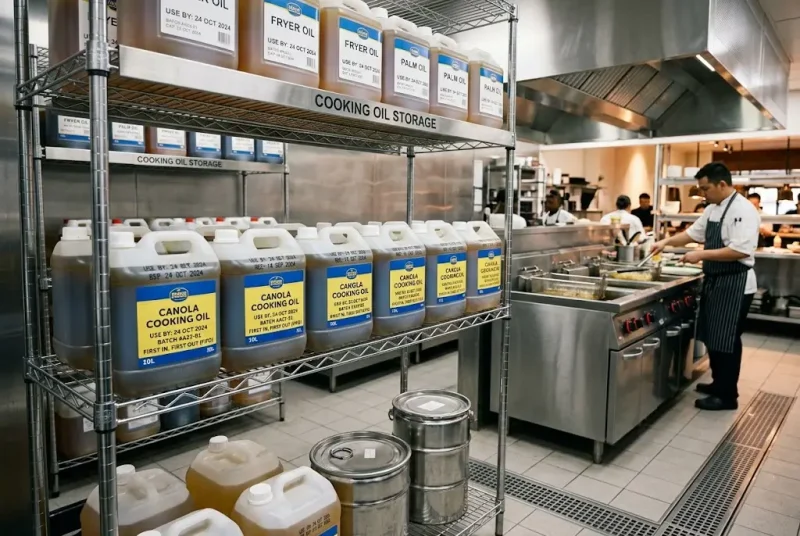

Proper frying oil storage and management is an important part of running a commercial kitchen. Restaurants, takeaways, cafés, hotels and catering businesses can use significant quantities of cooking oil, and poor handling can lead to unnecessary waste, inconsistent food quality and avoidable operating costs.
Buying a suitable oil is only the beginning. Once it arrives at the kitchen, businesses need a practical system for storing unused oil, managing oil in the fryer, filtering it when appropriate, monitoring its condition and disposing of it responsibly.
For businesses that purchase oil in larger quantities, good management becomes even more important because stock may remain on site for longer periods. Our bulk frying oil buying guide explains the purchasing considerations that should be evaluated before ordering larger quantities.
Why Frying Oil Management Matters
Frying oil is exposed to demanding conditions.
During normal commercial use, it comes into contact with:
- High temperatures
- Food particles
- Moisture
- Oxygen
- Seasonings
- Batter and breadcrumbs
- Cooking equipment
These factors can gradually affect the oil.
Poor management may result in changes to food flavor, color, texture and consistency.
A good system helps the kitchen use its oil efficiently while maintaining appropriate food quality and following safe operating practices.
Start With Proper Storage
Before oil reaches the fryer, it needs to be stored correctly.
Unopened containers should be kept according to the manufacturer’s instructions.
The storage area should ideally be:
- Clean
- Dry
- Well organized
- Away from excessive heat
- Protected from direct sunlight
- Free from unnecessary contamination
Oil should not simply be left wherever there is spare space.
Commercial kitchens often have busy storage areas, so keeping cooking oil in a designated location can make stock management much easier.
Protect Oil From Heat
Heat is useful when frying but undesirable during storage.
Unused oil should not be stored close to ovens, fryers, boilers or other sources of excessive heat unless the manufacturer specifically allows it.
A consistently hot storage environment can affect product quality over time.
Keeping oil in a suitable area away from unnecessary heat also makes stock rotation easier.
Keep Containers Closed
Exposure to air can contribute to changes in stored cooking oil.
Whenever possible, containers should remain sealed until the oil is required.
Once a container has been opened, follow the manufacturer’s storage recommendations and avoid leaving it open unnecessarily.
Staff should also make sure that caps, lids and dispensing equipment are clean before use.
Keep Water Away From Stored Oil
Water contamination is particularly important to avoid around cooking oil.
Even small amounts of water can create serious problems when introduced into hot oil because water rapidly turns into steam.
Storage areas should therefore remain dry.
Containers should be protected from leaks, spills and wet cleaning processes.
If a storage area is being cleaned, cooking-oil containers should be kept away from unnecessary exposure to water and cleaning chemicals.
Use Stock Rotation
Commercial kitchens can prevent unnecessary waste by using a simple stock-rotation system.
Older stock should generally be used before newer deliveries where appropriate.
This can help prevent containers from remaining in storage for unnecessarily long periods.
A useful approach is to label deliveries with relevant dates and organize containers so that staff can easily identify which stock should be used next.
Good stock rotation is especially important when buying oil in larger quantities.
Don’t Buy More Than You Can Store
Bulk purchasing can make sense for high-volume kitchens, but only if the business has sufficient storage capacity and predictable consumption.
Before ordering, consider:
- Average weekly oil usage
- Available storage space
- Delivery frequency
- Container sizes
- Expected shelf life
- Stock rotation
- Cash tied up in inventory
A lower price per litre does not automatically represent a saving if the business purchases more oil than it can use efficiently.
Understand Your Kitchen’s Oil Consumption
Every commercial kitchen has a different usage pattern.
Oil consumption can depend on:
- Number of fryers
- Fryer capacity
- Opening hours
- Menu
- Customer volume
- Food type
- Filtration practices
- Replacement schedule
Tracking consumption for several weeks can provide useful information.
For example, a business might record how much oil is added each day and how frequently the fryer is completely replaced.
This creates a realistic baseline for future purchasing decisions.
Managing Oil Inside the Fryer
Once oil enters the fryer, management becomes even more important.
The kitchen should maintain appropriate frying temperatures and avoid unnecessary overheating.
Staff should also avoid overloading the fryer.
Adding too much food at once can cause the oil temperature to fall sharply, affecting cooking performance.
The fryer should be operated according to the equipment manufacturer’s instructions.
Keep Food Particles Under Control
Small food particles can accumulate in frying oil.
Breadcrumbs, batter and pieces of food can continue cooking in the oil and eventually burn.
This can affect both oil condition and food flavor.
Regular removal of visible debris can therefore be an important part of oil management.
The exact method should depend on the fryer and the food being prepared.
Why Filtration Matters
Filtering frying oil removes food particles and other debris.
For busy kitchens, filtration can form part of a regular oil-management routine.
The frequency will depend on:
- Type of food
- Frying volume
- Fryer design
- Oil type
- Amount of debris produced
A kitchen preparing heavily battered foods may need to manage particles differently from one primarily frying frozen products.
The goal is to prevent unnecessary debris from remaining in the oil.
When to Filter Frying Oil
There is no universal filtration schedule for every business.
Some kitchens may filter at the end of each operating period, while others may use a different routine based on equipment and volume.
Follow the fryer manufacturer’s recommendations and establish a procedure that suits the kitchen.
Consistency is more important than having an arbitrary schedule.
Keep Fryer Temperature Consistent
Temperature control is one of the most important aspects of frying-oil management.
Excessive heat can accelerate oil deterioration.
Temperature that is too low can also create problems because food may absorb more oil and fail to develop the desired texture.
Staff should know the appropriate operating temperature for each food type and use reliable temperature controls.
Avoid Unnecessary Temperature Cycling
Constantly heating and cooling oil can contribute to inefficient operation.
Where appropriate, kitchens should establish procedures for fryer operation based on service patterns.
For example, a business with predictable lunch and dinner periods may have a different operating routine from a takeaway that remains busy throughout the day.
The equipment manufacturer’s guidance should always take priority.
Watch for Changes in Oil Condition
Staff should be trained to recognize changes in frying oil.
Potential warning signs can include:
- Unusual odors
- Excessive foaming
- Significant darkening
- Excessive smoking at normal temperatures
- Changes in frying performance
- Unusual food flavors
- Poor food color
- Increased greasiness
These signs should not be interpreted in isolation.
Oil condition depends on the food being cooked, equipment, temperature and management practices.
Businesses should follow appropriate food-safety procedures and manufacturer guidance when deciding whether oil should be replaced.
Don’t Rely Only on Color
Dark oil is not automatically unusable, just as clear oil is not automatically in perfect condition.
Color can be affected by the food being cooked and the type of oil.
A more reliable approach is to consider multiple indicators and use established kitchen procedures.
For larger operations, businesses may also use oil-quality testing methods where appropriate.
Keep Different Foods in Mind
Different foods can affect oil differently.
Battered Foods
Batter and breadcrumbs can create more particles and may require more frequent filtration.
Fish
Fish can introduce strong flavors into oil.
Some commercial kitchens use separate fryers to avoid flavor transfer.
Potatoes
Potatoes can affect oil through moisture and starch.
The cooking process and product type can influence oil performance.
Meat and Chicken
Seasonings, coatings and food particles can all influence the condition of the fryer oil.
Understanding how individual menu items affect oil can help businesses create more effective management routines.
Avoid Mixing Different Oils Without a Reason
Commercial kitchens should be careful about mixing different types of cooking oil.
Different oils can have different characteristics and may behave differently under heat.
If a business is changing products, staff should follow supplier and manufacturer recommendations rather than simply combining whatever remains in the fryer.
Consistency can make oil management easier.
Cleaning the Fryer
Oil management and fryer cleaning go together.
Residue can accumulate in the fryer itself and contribute to problems with subsequent batches.
Regular cleaning should follow the equipment manufacturer’s instructions.
Staff should understand:
- When cleaning is required
- Which cleaning products are suitable
- How to safely drain or handle oil
- How to remove residue
- How to prepare the fryer for fresh oil
A clean fryer provides a better foundation for consistent cooking.
Safe Handling of Hot Oil
Hot frying oil can cause serious burns.
Only properly trained staff should handle hot oil.
Kitchen procedures should cover:
- Safe draining
- Appropriate protective equipment
- Moving oil containers
- Filtering procedures
- Spill response
- Fryer cleaning
- Emergency procedures
Hot oil should never be handled casually, even when staff are experienced.
Storing Used Frying Oil
Used oil should be handled according to the business’s food-safety procedures and local waste requirements.
If oil is temporarily stored before disposal or recycling, it should be placed in an appropriate container designed for the purpose.
Never pour hot oil into sinks or drains.
It can create blockages and may cause plumbing and environmental problems.
Responsible Frying Oil Disposal
Commercial kitchens can produce substantial quantities of used cooking oil.
Businesses should use appropriate collection or recycling services where available.
Used cooking oil can sometimes be collected for recycling or processing into other products.
The exact requirements depend on local regulations and waste-management arrangements.
Maintaining a clear disposal procedure helps prevent accidental environmental damage and makes kitchen operations more organized.
Create a Frying Oil Log
A simple oil log can make management much easier.
Staff can record:
- Date oil was added
- Amount added
- Filtration
- Oil replacement
- Fryer cleaning
- Unusual observations
- Supplier or product used
The goal is not to create unnecessary paperwork.
A basic record can help identify patterns.
For example, if a particular fryer consistently requires more frequent oil replacement, management can investigate whether the issue is related to food volume, temperature, filtration or equipment.
Train Every Staff Member
Oil management should not depend on one experienced employee.
Every member of the kitchen team who handles the fryer should understand the basic procedures.
Training should cover:
- Temperature control
- Fryer loading
- Filtration
- Safe handling
- Cleaning
- Oil-quality checks
- Replacement procedures
- Waste disposal
Written procedures can help maintain consistency between shifts.
How to Reduce Unnecessary Oil Waste
Better management can reduce waste without compromising food quality.
Useful practices include:
Avoid Overfilling Fryers
Only use the amount of oil required by the equipment.
Control Food Loads
Overloading can affect temperature and cooking performance.
Filter Appropriately
Remove food particles according to the kitchen’s established procedure.
Maintain Equipment
Clean equipment can support better oil performance.
Monitor Consumption
Track how much oil is actually being used.
Improve Stock Rotation
Avoid unnecessary long-term storage.
Bulk Oil and Storage Planning
Businesses purchasing large quantities should think about storage before placing an order.
Consider where containers will be kept and whether staff can access them safely.
The storage area should also allow the business to rotate stock effectively.
If a restaurant has limited storage space, more frequent smaller deliveries may be more practical than a very large order.
For businesses with high consumption and adequate storage, larger purchases can simplify supply management.
The key is to match purchasing volume with actual operational needs.
Choosing the Right Container Size
There is no universal best container size.
Smaller containers may be easier for staff to handle and may suit businesses with moderate consumption.
Larger containers can be more efficient for high-volume operations but require appropriate handling and storage.
Consider:
- Staff handling
- Storage capacity
- Daily consumption
- Delivery frequency
- Safety
- Stock rotation
The cheapest price per litre may not be the most practical option if the packaging is difficult to handle.
Build a Simple Daily Routine
A practical commercial kitchen routine could look like this:
Before service:
Check fryer condition, oil level and equipment.
During service:
Monitor temperature, avoid overloading and remove visible food debris.
After service:
Filter where appropriate, check oil condition and clean equipment according to procedure.
Regularly:
Review oil consumption and replacement frequency.
When ordering:
Compare current stock with expected usage and upcoming demand.
This kind of routine makes oil management part of normal kitchen operations rather than an occasional task.
How Good Management Supports Food Quality
Proper oil management can help maintain consistency in:
- Crispness
- Color
- Flavor
- Texture
- Cooking time
Customers may not know what type of frying oil a restaurant uses, but they can notice when fried food tastes stale, greasy or inconsistent.
For that reason, oil management should be considered part of quality control rather than simply a cost-saving exercise.
Frequently Asked Questions
How should frying oil be stored in a commercial kitchen?
Unopened oil should generally be stored in a clean, dry location away from excessive heat and direct sunlight, following the manufacturer’s specific recommendations.
How long can frying oil be stored?
Storage life depends on the product, packaging and conditions. Always follow the manufacturer’s stated shelf-life and storage guidance.
Should frying oil be kept refrigerated?
Not normally unless the manufacturer specifically recommends it. Commercial cooking oil should be stored according to the product’s instructions.
How often should frying oil be filtered?
There is no universal schedule. Filtration frequency depends on the food being cooked, fryer, oil and operating volume.
How do I know when frying oil needs replacing?
Changes in smell, foaming, smoking behavior, color, food quality or frying performance can indicate that oil needs attention. Follow established food-safety procedures and manufacturer guidance.
Can different frying oils be mixed?
Businesses should avoid mixing oils without checking whether the products are compatible and whether doing so is appropriate for their equipment and food-safety procedures.
Can used frying oil be recycled?
Used cooking oil can often be collected for recycling or processing, depending on local waste-management services and regulations.
Can I pour used frying oil down the sink?
No. Used oil should not be poured into sinks or drains because it can cause blockages and environmental problems.
Does filtering make frying oil last longer?
Filtering removes food particles that can contribute to oil deterioration, but the overall effect depends on the oil, food, temperature and management practices.
Is buying frying oil in bulk a good idea?
It can be beneficial for high-volume kitchens with suitable storage and predictable consumption. Businesses should compare purchase price, storage capacity, stock rotation and actual usage before ordering large quantities.
Final Thoughts
Effective commercial frying oil management starts long before the fryer is switched on.
Businesses need to store unused oil correctly, rotate stock, control frying temperatures, remove food particles, clean equipment and monitor oil condition. A consistent routine can help reduce unnecessary waste while supporting reliable food quality.
For kitchens that purchase substantial quantities, storage planning is particularly important. Buying more oil only makes sense when the business has sufficient consumption and suitable facilities to store and manage it.
If you are reviewing your purchasing strategy as well as your storage procedures, read the bulk frying oil buying guide for a broader look at commercial purchasing considerations.
The most effective approach is to treat frying oil as part of the kitchen’s overall quality-control system. When purchasing, storage, frying, filtration, cleaning and disposal are managed together, commercial kitchens can operate more consistently and reduce avoidable waste.
