
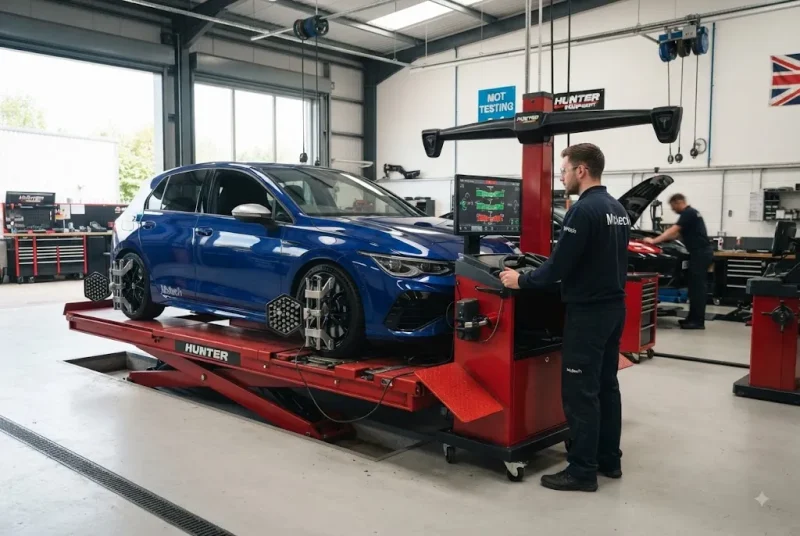

Wheel alignment is an important part of vehicle maintenance that can affect tyre life, steering behaviour, handling and overall vehicle efficiency. When the wheels are not correctly aligned, tyres may wear unevenly and the vehicle may pull to one side or require constant steering correction. Over time, these issues can lead to unnecessary tyre replacement and reduced driving efficiency.
For UK motorists, checking alignment can therefore be more than a comfort or handling issue. Correct steering alignment can help protect tyres, support efficient vehicle operation and reduce avoidable waste. It is particularly relevant when a vehicle has hit a pothole or kerb, suspension components have been replaced, or uneven tyre wear becomes visible.
This guide explains how wheel alignment works, when it may be needed, how it differs from wheel balancing, and why correct alignment can contribute to lower tyre wear and more efficient motoring.
What Is Wheel Alignment?
Wheel alignment is the process of checking and, where necessary, adjusting the angles of a vehicle’s wheels so they meet the manufacturer’s specifications.
Alignment involves several geometric measurements. Depending on the vehicle, these can include camber, caster and toe. Each measurement influences how the wheel sits relative to the vehicle and the road.
The exact specifications vary between vehicles. A technician therefore needs the correct information for the specific make and model rather than relying on a universal setting.
Correct alignment helps the tyres maintain their intended relationship with the road. When alignment is outside specification, the vehicle may experience abnormal tyre wear, steering problems or changes in handling.
Wheel Alignment and Tyre Wear Reduction
One of the main reasons motorists have their alignment checked is uneven or premature tyre wear. A wheel that is incorrectly positioned can place additional stress on particular areas of the tread.
Instead of wearing evenly across the tyre, the tread may develop patterns that indicate an alignment or suspension problem. The exact pattern can vary depending on the underlying fault.
The UK government’s Highway Code guidance states that excessive or uneven tyre wear can be caused by braking or suspension faults or wheels that are out of alignment. It also advises motorists to have these faults corrected promptly.
Correcting an alignment issue will not restore tread that has already been worn away. However, addressing the underlying problem can help prevent a replacement tyre from suffering the same abnormal wear.
Common signs of alignment-related wear
Drivers may notice several warning signs when alignment needs attention:
- Uneven wear across the tread.
- Faster wear on one side of a tyre.
- The vehicle pulling towards one side.
- The steering wheel appearing off-centre when driving straight.
- Unusual steering behaviour.
- Tyres wearing sooner than expected.
These symptoms do not automatically prove that alignment is the problem. Tyre pressure, suspension condition, braking faults and other mechanical issues can produce similar symptoms. A proper inspection is therefore preferable to guessing from appearance alone.
How Wheel Alignment Can Support Vehicle Efficiency
Vehicle efficiency depends on many factors, including engine or motor performance, driving style, vehicle weight, tyre pressure and tyre characteristics. Wheel alignment is one part of this wider picture.
A vehicle with poorly aligned wheels may experience unwanted tyre scrub or resistance as the tyres move along the road. This can contribute to unnecessary tyre wear and may increase the effort required to move the vehicle.
Tyres themselves also have a significant relationship with energy consumption. The Vehicle Certification Agency states that tyre rolling resistance contributes to fuel consumption and that reducing rolling resistance can improve fuel efficiency and reduce greenhouse gas emissions.
This does not mean that correcting alignment will produce a fixed percentage improvement in fuel economy. The effect depends on the severity of the alignment problem and the vehicle. However, maintaining the wheels, tyres and suspension in good condition supports the broader goal of efficient vehicle operation.
Wheel Alignment and Fuel Efficiency
Fuel efficiency is particularly relevant to drivers covering high annual mileages, including commuters, business users and fleet operators.
Small inefficiencies can accumulate over thousands of miles. Correct tyre pressure, suitable tyres and proper maintenance can all contribute to reducing unnecessary energy use.
The VCA explains that tyres can account for a substantial proportion of a vehicle’s fuel consumption because of rolling resistance. Its tyre-labelling information also notes a difference in fuel economy between the best and worst rolling-resistance classes.
Alignment should therefore be considered alongside tyre pressure and tyre selection rather than treated as an isolated efficiency measure.
The UK government’s guidance for maintaining commercial vehicles similarly links correct tyre inflation and energy-efficient tyres with lower fuel consumption.
Wheel Balancing vs Wheel Alignment
Wheel balancing and alignment are often confused because both involve wheels and tyres, but they address different problems.
The Wheel alignment
Alignment concerns the geometric position and direction of the wheels. A technician measures the relevant angles and adjusts the vehicle where adjustment is available and required.
Wheel balancing
Balancing addresses the distribution of weight around the wheel and tyre assembly. Small imbalances can cause vibration, particularly at certain speeds.
A vehicle can therefore have good alignment but still need wheel balancing. Likewise, a balanced wheel can still be incorrectly aligned on the vehicle.
When a customer reports steering vibration, pulling or uneven tyre wear, a technician may need to investigate several possible causes rather than assuming that one service will solve every problem.
When Should You Get Wheel Alignment Checked?
There is no single mileage interval that applies to every vehicle. Alignment should be considered when circumstances suggest that the wheel geometry may have changed.
Useful occasions for an alignment inspection include:
- After hitting a significant pothole.
- After striking a kerb.
- When fitting certain suspension components.
- After steering or suspension repairs.
- When replacing tyres because of unusual wear.
- When the vehicle begins pulling to one side.
- When the steering wheel is no longer centred.
- When tyre wear appears uneven.
UK roads can expose vehicles to potholes, damaged surfaces and uneven road conditions. A significant impact does not necessarily mean that alignment has changed, but an inspection can help identify problems before they cause further tyre wear.
Why Correct Tyre Pressure Matters Too
Alignment is only one part of good tyre management. Correct tyre pressure is equally important for safety, tyre life and efficiency.
Under-inflated tyres create greater rolling resistance, meaning the vehicle requires more energy to move. The Vehicle Certification Agency recommends checking tyre pressures regularly, while GOV.UK guidance states that tyres should be correctly inflated according to the manufacturer’s specification.
Incorrect pressure can also contribute to uneven wear. A driver who has alignment checked but ignores tyre pressure may therefore continue to experience unnecessary tyre degradation.
The best approach is to treat alignment, pressure, tread condition and suspension health as connected parts of vehicle maintenance.
How Steering Alignment Affects Driving
Correct steering alignment can contribute to predictable handling. When wheel angles are outside specification, a vehicle may feel less settled or require more steering correction.
A driver might notice that the car drifts when travelling on a relatively straight road. However, road camber can also influence how a vehicle feels, particularly on roads that slope towards the edge for drainage.
For this reason, a technician should assess the vehicle rather than diagnosing alignment solely from a short drive.
Wheel Alignment After Suspension Repairs
Suspension and steering components determine how the wheels are positioned relative to the vehicle. Replacing or adjusting certain components can therefore affect alignment.
For example, work involving track rods, steering components or other alignment-related parts may change the vehicle’s geometry. Depending on the repair, an alignment check may be appropriate afterwards.
However, not every repair automatically requires a full alignment adjustment. The correct procedure depends on the vehicle and the components involved.
Professional workshops should use the manufacturer’s specifications and suitable alignment equipment when checking the vehicle.
Wheel Alignment for Electric and Hybrid Vehicles
Wheel alignment is relevant to electric and hybrid vehicles just as it is to conventional cars. The propulsion system may differ, but the vehicle still relies on tyres, steering and suspension to transfer forces to the road.
Electric vehicles can also place particular importance on tyre efficiency because rolling resistance influences the energy required to move the vehicle. Drivers therefore have another reason to pay attention to tyre condition and alignment.
For owners of hybrid vehicles, alignment is similarly connected to efficient operation and tyre longevity. Our guide to hybrid servicing and sustainable hybrid maintenance explains how broader maintenance practices can support longer and more efficient vehicle use.
Drivers considering specialist electric vehicle maintenance can also explore our guide to EV servicing and electric vehicle maintenance.
How Wheel Alignment Supports Sustainability
Sustainability in automotive maintenance is not limited to electric vehicles or renewable energy. Extending the useful life of components can also reduce resource consumption.
Tyres require raw materials, manufacturing energy, transportation and processing. If poor alignment causes a tyre to wear prematurely, replacing it earlier than necessary means additional resources are required.
Reducing unnecessary tyre wear can therefore support a more resource-efficient approach to vehicle ownership.
This fits within the wider environmental practices used by automotive service companies. Responsible workshops can combine accurate maintenance with waste reduction, appropriate recycling and efficient use of workshop resources.
Wheel Alignment and Lower Emissions
It is important not to overstate the environmental effect of alignment. A wheel alignment check is not itself a major emissions-reduction technology. Its contribution is indirect and depends on the condition of the vehicle.
Correct alignment can help prevent abnormal tyre wear and may reduce unnecessary rolling resistance associated with a vehicle that is not operating correctly. Maintaining tyres at the correct pressure also supports efficiency.
For conventional vehicles, improved efficiency can mean less fuel consumed for a given journey. For electric vehicles, efficient tyre and wheel performance can contribute to lower energy consumption per mile.
The UK government has highlighted the relationship between tyre pressure, fuel consumption and tyre life, reinforcing the value of proper tyre management as part of efficient vehicle operation.
What Happens During a Wheel Alignment Check?
A professional alignment service normally begins with an inspection of the vehicle and tyres. The technician may check tyre condition, steering and suspension components before measuring the wheel geometry.
Modern alignment equipment can measure the relevant angles and compare them with manufacturer specifications.
If adjustment is required and the vehicle design allows it, the technician can make the appropriate changes. Some vehicles have more adjustment options than others, and worn or damaged components may need repair before alignment can be completed correctly.
This is why alignment should not simply be viewed as turning adjustment bolts until the readings appear acceptable. The condition of the underlying steering and suspension systems matters too.
How Much Does Wheel Alignment Matter for Tyre Life?
The effect varies according to the severity and type of misalignment. A small deviation may produce little noticeable effect, while a more significant issue can contribute to rapid or uneven tread wear.
Because tyre wear is affected by multiple factors, it is difficult to promise a specific number of extra miles from an alignment service.
Nevertheless, correcting an identified alignment problem can prevent the same abnormal wear pattern from continuing. That can be particularly valuable when a driver has just invested in a new set of tyres.
Choosing a UK Workshop for Wheel Alignment
Drivers should look for a workshop with appropriate alignment equipment and technicians who understand the specifications of the vehicle being serviced.
It can also be useful to ask whether the workshop checks steering and suspension condition before carrying out adjustments. If a component is worn or damaged, simply adjusting the alignment may not resolve the underlying problem.
National garage chains and independent workshops can both provide alignment services. The most important consideration is the quality of the inspection, equipment and technical work.
For motorists comparing larger networks, our guide to sustainable UK garage chains provides additional context on responsible workshop practices and how environmental considerations are becoming part of automotive services.
Simple Tyre and Alignment Habits for Drivers
Drivers can reduce the likelihood of tyre-related problems by adopting a few straightforward habits:
- Check tyre pressures regularly when the tyres are cold.
- Inspect tread and sidewalls for visible damage.
- Pay attention to unusual steering behaviour.
- Have significant pothole or kerb impacts checked when appropriate.
- Investigate uneven tyre wear instead of simply replacing the tyre.
- Follow the vehicle manufacturer’s maintenance recommendations.
- Have steering and suspension faults repaired promptly.
- Use suitable replacement tyres for the vehicle.
The Highway Code states that car and light-van tyres must meet the applicable minimum tread-depth requirement and should be correctly inflated to the manufacturer’s specification.
The Role of Wheel Alignment in Sustainable Automotive Maintenance
As the UK automotive sector focuses more heavily on sustainability, routine maintenance can play a useful supporting role. Preventing premature tyre wear reduces avoidable material consumption, while maintaining correct tyre and wheel condition can support efficient vehicle operation.
This principle applies across petrol, diesel, hybrid and electric vehicles. The propulsion technology changes, but tyres and steering remain fundamental to safe and efficient road use.
For workshops, alignment checks can therefore become part of a broader maintenance approach that focuses on vehicle longevity, responsible parts use and reduced waste.
Final Thoughts
Wheel alignment is a relatively straightforward maintenance service, but its effects can extend across tyre wear, steering behaviour, handling and vehicle efficiency. When wheel geometry moves outside the manufacturer’s specifications, tyres may wear unevenly and the vehicle may not perform as intended.
Alignment should be considered alongside tyre pressure, wheel balancing, suspension condition and tyre selection. No single maintenance service can guarantee lower fuel consumption or longer tyre life, but keeping these systems in good condition helps reduce avoidable inefficiencies.
For UK motorists, the most sensible approach is to investigate warning signs such as uneven wear, steering pull or an off-centre steering wheel rather than waiting for a tyre to fail. A professional inspection can identify whether alignment, suspension, pressure or another issue needs attention.
By maintaining wheels and tyres correctly, drivers can support safer motoring, reduce premature tyre replacement and contribute to a more resource-efficient approach to vehicle ownership.
